§ Journal · Jun 2, 2026
Battery Wall Mount Compatibility in 2026 — DeWalt, Milwaukee, Makita, and More
Battery mounts are brand-specific. This guide covers which wall mounts fit each major battery platform and how to plan a multi-brand storage wall.
Published
Battery Wall Mount Compatibility in 2026 — DeWalt, Milwaukee, Makita, and More
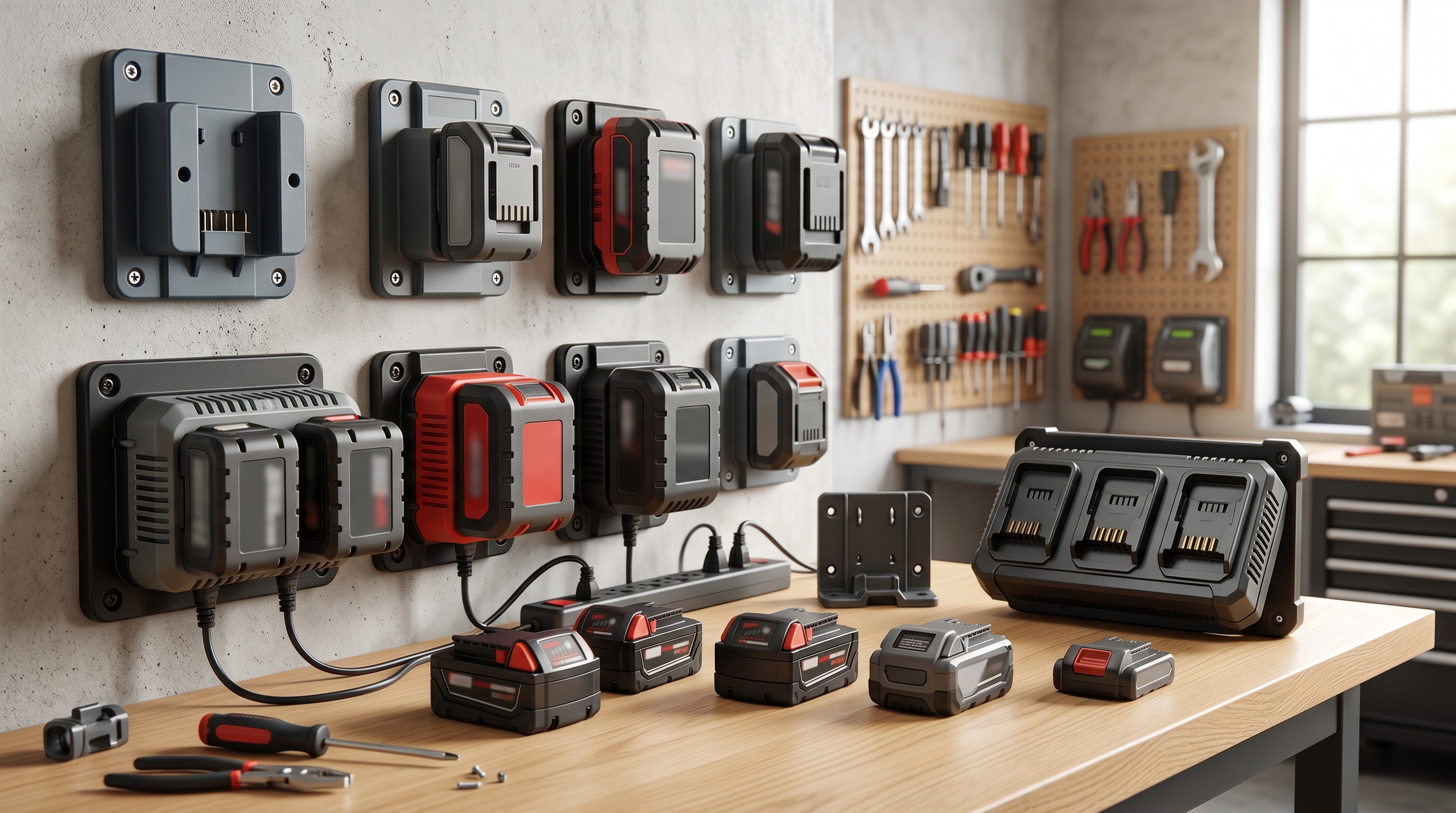
If your garage or workshop has slowly turned into a shelf full of loose cordless tool batteries, 2026 is a good time to fix it. Battery wall mounts are one of the simplest upgrades you can make to a shop: they clean up clutter, protect expensive packs, and make it easier to grab the right battery when it’s time to work. For anyone running multiple cordless platforms, compatibility matters. Not every battery fits every mount, and even within a brand there are important exceptions.
For DIYers, contractors, and serious workshop organizers, here’s what to know about battery wall mount compatibility across the major cordless tool brands.
Why battery organization matters
Battery organization is about more than looks. First, it improves safety. Loose batteries tossed into drawers or bins can collect metal fasteners, cutoff screws, or other conductive debris around the terminals. While most modern packs have built-in protection, preventing accidental contact is still the smarter approach. A proper wall mount keeps each battery secured and separated, reducing the chance of shorts or damaged contacts.
Second, organization adds convenience. When batteries are lined up by platform, voltage, or state of charge, you spend less time hunting and more time working. That matters whether you’re switching from a drill to an impact driver on a home project or moving through a full day of jobsite tasks.
Third, storage can affect battery longevity. Batteries do best when they’re stored in a stable environment, upright and protected from being knocked around. A dedicated mount helps prevent drops, cracked housings, and unnecessary stress on the slide rails that lock into tools and chargers.
DeWalt 20V MAX mounts
DeWalt remains one of the most common systems in garages and pro shops, and most battery mounts designed for DeWalt focus on the 20V MAX slide-pack format. That includes the familiar DCB200-series batteries, such as the DCB200, DCB203, DCB204, DCB205, and compact PowerStack options like the DCBP034.
These batteries share the same slide-in rail profile, so a properly designed DeWalt 20V MAX wall mount will usually fit them all. For most users, that means one mount style covers the majority of their yellow-and-black battery lineup.
The exception is FlexVolt 60V. Batteries like the DCB606, DCB609, and DCB612 are physically larger and heavier. Although they can power many 20V MAX tools, they do not reliably fit standard 20V MAX battery mounts unless the mount is specifically designed to accommodate their larger dimensions and weight. If you use FlexVolt regularly, look for a mount advertised specifically for DeWalt FlexVolt 20V/60V batteries rather than assuming your standard DCB200-series holder will work.
Milwaukee M18 mounts
Milwaukee’s M18 platform is straightforward in a good way. A quality M18 battery mount should fit the full M18 family, including standard packs, High Output, and the newer FORGE batteries. That includes common battery models such as the 48-11-1815, 48-11-1820, 48-11-1850, 48-11-1880, and larger packs built on the same M18 slide interface.
This is good news for users heavily invested in Milwaukee: one mount type can usually organize everything in your M18 system, from compact batteries used in drills to larger packs reserved for saws, grinders, and outdoor power equipment.
What does not fit is M12. Milwaukee’s 12V batteries use an entirely different footprint and insertion style, so they require their own dedicated mounts. If your shop runs both M18 and M12, plan on separate rows and separate holders for each platform. Mixing them visually may look tidy at first, but it tends to slow things down when you’re trying to grab batteries quickly.
Makita 18V LXT mounts
Makita users benefit from one of the cleanest compatibility stories in cordless tools. The 18V LXT platform uses a consistent battery rail across the lineup, and the common BL-series batteries all share that same mount interface. Models like the BL1815N, BL1830B, BL1840B, BL1850B, and BL1860B all slide onto the same style of wall mount.
In practical terms, that makes Makita 18V LXT mounts universal within the platform. If your tools run on LXT, one mount pattern will generally serve your entire battery collection. For organized walls, that’s ideal: simple, repeatable, and easy to scale as your battery count grows.
As always, check for fit if you’re using unusual accessories or niche battery formats, but for mainstream Makita 18V users, compatibility is refreshingly consistent.
Ryobi ONE+ 18V mounts
Ryobi’s ONE+ 18V system is another platform with broad internal compatibility. From smaller packs around 1.5Ah up through larger 9Ah batteries, the mount interface is the same. Whether you’re storing compact batteries for light-duty drills or larger packs for shop vacs and outdoor tools, a Ryobi ONE+ battery wall mount should support the entire 18V lineup.
That broad compatibility is one reason Ryobi storage systems are popular with homeowners and garage tinkerers: one battery rail style, one mounting approach, less guesswork.
The important distinction is Ryobi 40V. Those batteries are a separate platform with a different shape, size, and weight. They need dedicated 40V mounts and should not be forced into ONE+ holders.
EGO 56V mounts
EGO’s 56V ARC Lithium batteries are in a different category from compact tool batteries. They are physically larger, heavier, and built for outdoor power equipment. That means they require wider, stronger mounts designed specifically around the EGO battery housing.
If you’re planning to mount EGO packs alongside drill and saw batteries, remember that these are not just oversized versions of standard tool batteries. They need more wall space, better support, and careful placement. There is also no cross-compatibility between EGO mounts and the major hand-tool battery platforms like DeWalt, Milwaukee, Makita, or Ryobi.
Planning a multi-brand wall
If you use more than one cordless brand, layout matters almost as much as compatibility. Start with spacing. Leave enough room above and beside each mount so larger packs can slide in and out without binding. Tight spacing might look efficient on paper, but it becomes frustrating fast, especially with high-capacity batteries.
Next, think about load-bearing capacity. A row of compact batteries is one thing; a wall full of FlexVolt, High Output, FORGE, or EGO packs adds up quickly. Use solid mounting hardware and attach your storage system to studs, plywood backer panels, or another structurally sound surface.
Finally, group by platform. Keep DeWalt with DeWalt, M18 with M18, M12 separate, and so on. If you run chargers nearby, align battery rows with their matching charging stations for an even smoother workflow.
Aftermarket vs. 3D-printed mounts
There’s a big difference between a well-made aftermarket mount and a casual 3D-printed one. Good aftermarket injection-molded mounts are typically stronger, more dimensionally consistent, and better suited to repeated daily use. They hold tolerances more reliably, which matters when battery rails need to slide in smoothly but still lock securely.
Some 3D-printed mounts are decent for light-duty storage, but print quality varies, material strength varies, and layer lines can become weak points over time. For heavier batteries or high-use shops, injection-molded mounts are the safer long-term choice.
Pro tip: label your mounts
One final tip: label your mounts. It sounds simple, but once your collection grows past 20 batteries, clear labels save time every day. Mark rows by brand, voltage, or even battery status categories like “charged,” “to charge,” or “reserve.” When your wall is full and every pack looks familiar, those labels become one of the smartest organization tools in the shop.
In 2026, battery wall storage is no longer just a nice extra. It’s part of building a safer, cleaner, more efficient workspace. And when you choose mounts designed for the exact battery platform you use, your wall works as hard as your tools do.
Find the right part on Amazon
Check price, stock and fitment — ships direct from Amazon.
§ Catalog
Shop the catalog


